Mary Ward:
First Sister of Feminism
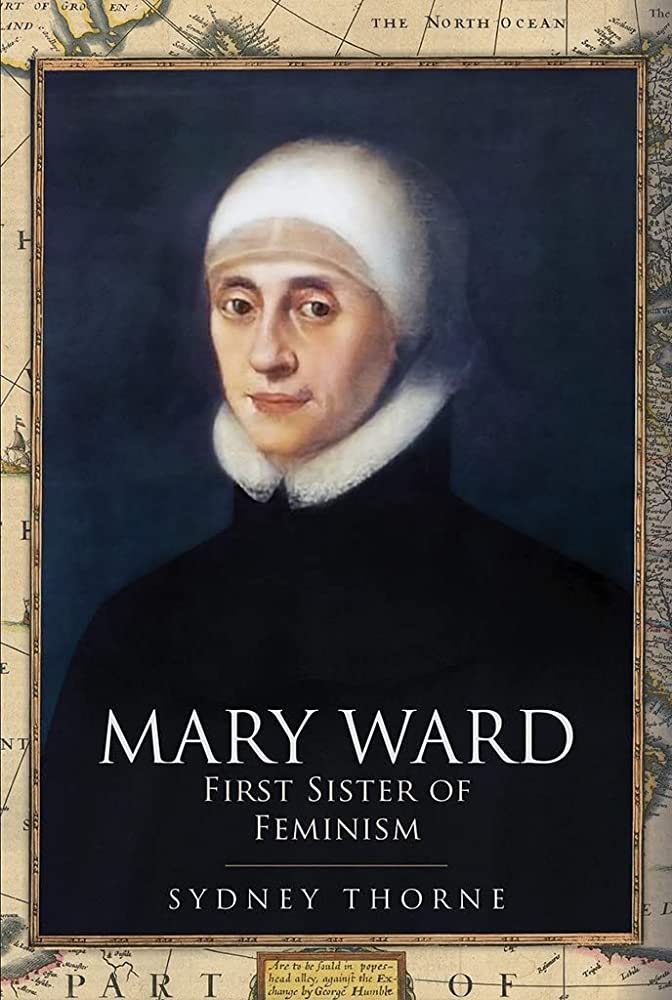
Almost exactly 400 years ago, an English woman completed an astonishing walk to Rome.
An English Catholic, Mary Ward had already defied the authorities in England. In 1621 she walked across Europe to ask the Pope to allow her to set up schools for girls. ‘There is no such difference between men and women that women may not do great things,’ she said.
But Mary’s vision of equality between men and women angered the Catholic Church and the Pope threw her into prison. This is a story just waiting to be told.
The story shines a refreshingly new light on the popular Tudor/Stuart era. Mary’s uncles are the Gunpowder Plotters. Her sponsors are Archdukes, Prince-Archbishops and the Emperor of the Holy Roman Empire. In Rome she spars with Pope Urban VIII and the Roman Inquisition, just as they are also dealing with Galileo.
As the story sweeps from Yorkshire to Rome, from Vienna and Munich to Prague and back to England, we see Mary dodging pirates in the Channel, witch hunts in Germany and the plague in Italy. We see travellers crossing the Alps, and prisoners writing letters in invisible lemon juice to smuggle them past their gaolers. The settings range from the resplendent courts in Brussels and Munich to the siege of York in the English Civil War. As you read this book you will be immersed in seventeenth-century life.
What a fascinating book this turned out to be … . I’d never heard of Mary Ward and I’m so glad I now have. Religious sister Mary Ward (1585-1645) was a remarkable woman… Overall this is a well-written, thoroughly researched and engaging biography and a worthy tribute to this amazing woman.
— Mandy Jenkinson, NetGalley
I love reading about powerful women in history, and Thorne did such an amazing job bringing Mary Ward’s story to life. At times I felt like I was walking and fighting right along with her. Ward’s story is a fascinating one, I am definitely going to read up on her and her sisters more.
Even if Catholic history isn’t your thing, you will definitely enjoy this book.
— Aiya Messina, NetGalley
As an alumni of a Loreto school, I was really honoured and intrigued to be able to read this book. It was amazing to read about the journey that Mary Ward took to establish her schools and it was particularly awe-inspiring to be able to reflect on my years at school and the lasting impact that what Mary Ward did over 450 years ago… This book also provides a really interesting snapshot into Europe in the late 1500s to mid 1600s.
— Sephi Coleman-Tunney, NetGalley
This is the amazing story of a lady who changed the course of history – her forays into battle against the Catholic church whilst so much of the Inquisition was centering on staggeringly famous historical figures are amazing, and, as the blurb says, this was a story just waiting to be told. Mary’s lineage is quite incredible, and the story is told with verve and excitement. Thoroughly enjoyable account of a remarkable lady’s life.
— Books Monthly
What an absolute joy it was to read this book about an amazing figure of early feminism, written by a man!
Finally, not only female authors find it important to learn and tell the world more about influential women in history. Here comes a man, Sydney Thorne, introducing rarely-discussed Mary Ward to us, and paying her due respect. This is an informative read, and since the tone of voice is not too formal, very entertaining and easy-going too.
You’ll be shocked to learn how many things have not changed a bit in women’s life, rights or status since the 17th century, and how much Mary Ward did to empower other women, facilitate girls’ education and take a step towards gender equality.
— Anita Salát, NetGalley
More Precious Than Gold:
The amazing influence and trade of alum across the ages
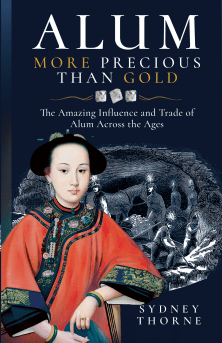
Never heard of alum? You’re not alone.
Yet for centuries alum was vital to the production of coloured cloth. Alum was needed to fix dyes and colours to the cloth. Without alum, the colours ran and faded. With alum they shone and were fast.
As a result, alum was, as the Italian scientist Vanoccio Biringucci put it in the 16th century, as ‘essential to dyers as bread is to man’. Corner the market in alum and you could make a fortune.
Manufactured from a rock called alunite that was mined in China, Egypt and Turkey, alum contributed to the fabulous wealth of the Chinese emperors, the Pharaohs, the Byzantines and the Ottomans.
A prized commodity in international trade, alum funded the opulence of Genoa, Bruges and late
Renaissance Rome. It was cannily exploited by Henry VII but it nearly ruined Elizabeth I.
But alum also allowed crooks to make debased coins and to adulterate bread, and was at the heart of one of the most spectacular bankruptcy scandals of the 18th century. And the Black Death used the shipping routes of the alum trade to spread through Europe.
In this fascinating and eminently readable book, Sydney Thorne has picked out quirky and exciting
stories of alum that range across the centuries and across the world, shedding new light on topics
ranging from the slave trade to female entrepreneurs, while re-discovering a fully-fledged industrial complex on the Yorkshire coast that was thriving two hundred years before the industrial revolution.
A unique, seminal, deftly written, documented, and ground-breaking history, “Alum, More Precious than Gold: The Amazing Influence and Trade of Alum Across the Ages” is an especially and unreservedly recommended addition to personal, professional, community, and college/university library International Economic History collections and supplemental curriculum studies lists.
— Midwest Book Review
 Sydney Thorne